Employees must
- assess safety during the performance of work, including the use of protective equipment.
- in case of missing or damaged equipment or clothing, contact the immediate supervisor without undue delay to receive replacements.
- handle issued protective equipment and workwear with care.
- follow up on the maintenance of workwear and protective equipment according to instructions.
- ensure that protective equipment is clean and in good condition.
- maintain good hand hygiene and contribute to good infection control.
Employees must not
- wear rings or other jewelry that may pose a risk in work situations involving tasks on vehicles, machines, or mechanical equipment.
WORKWEAR – JACKET AND TROUSERS
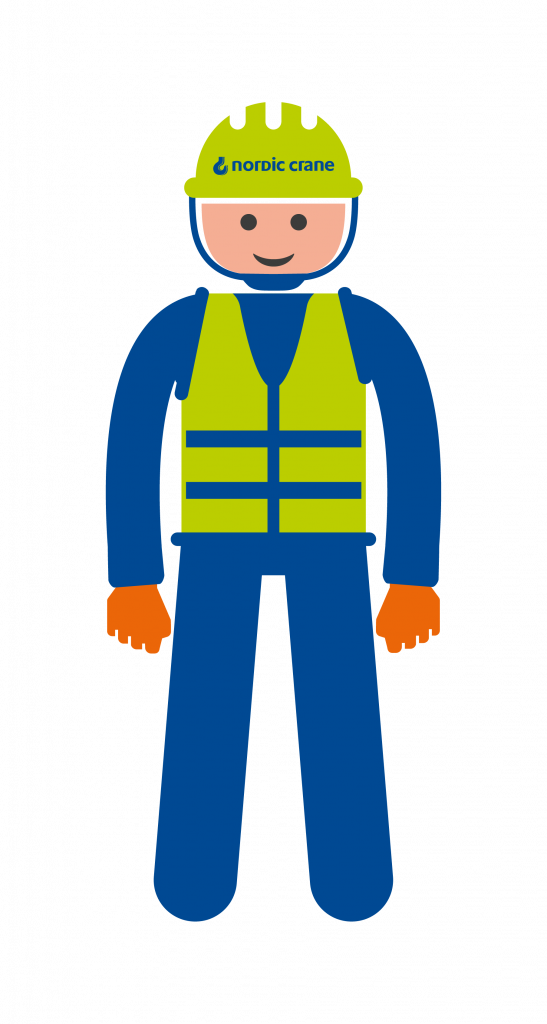
By jacket and trousers, we mean approved workwear in accordance with visibility standard EN ISO-20471 Class 3.
To meet visibility standard EN ISO-20471 Class 3, both short and long jackets, sweaters, T-shirts, coveralls, and vests must be Class 3, and trousers must at least meet Class 2.
- Only workwear approved by the employer with the current logo may be used. (Fleece jackets are not approved workwear and must not be used as the outermost garment.)
- Always follow instructions on correct use of workwear and site-specific requirements, for example on construction sites.
- Clothing with “loose” outer pockets that may catch on objects should not be worn.
HELMET
- A helmet must be worn in all work operations on construction sites when outside the cab or upper structure.
- When working at height, a helmet must always be worn.
- The chin strap must always be fastened.
HELMET COLOUR CODES
Nordic Crane uses the following helmet colour codes:
- White for Nordic Crane employees
- Green for safety representatives and HSE
- Yellow for guests / visitors
SAFETY SHOES
- Safety shoes must be worn during all work operations.
- Exceptions may apply during transport and driving.
- It is not permitted to use safety clogs except when driving. When working outside of trucks, cranes, and crane trucks, safety shoes must be worn.
HEARING PROTECTION AND SAFETY GLASSES
- If the noise source cannot be reduced or eliminated, appropriate hearing protection must be used.
- Hearing protection must always be used if the noise level exceeds 85 dB on average over a workday and/or if impulse noise exceeds 130 dB.
- Hearing protection should also be used when average noise over a workday is above 80 dB.
- It is prohibited to use hearing protection with music or radio.
- Safety glasses must always be carried and used on construction sites where required.
- Safety glasses must also be worn in any work situation where there is a risk of eye injury.
- Loss of or obvious defects in personal protective equipment must be reported by the employee in Simpli Better as an Unwanted Incident or Improvement Suggestion.